Editors’ Note: This article is based on independent analysis and a survey conducted by The Voice. These findings are meant to offer a preliminary look at campus trends. For definitive results, a certified procedure should be used.
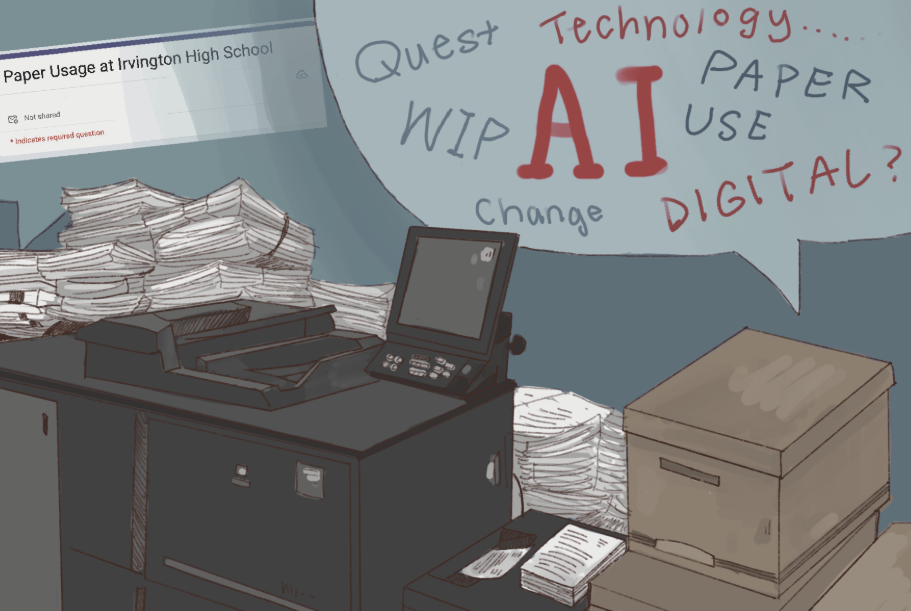
Every morning, the three copy machines at Irvington High School are refilled with 3,000 sheets of paper each. On busy days, they get refilled again before lunch. Because teachers print over 40 weeks of school, a conservative estimate puts Irvington’s annual teacher printing alone at roughly 670,000 sheets — somewhere between 66 and 84 trees’ worth of paper.
For years, the education sector has put an increasing emphasis on screens, with Chromebooks, digital submissions and paperless classrooms taking the “industry” by storm. But a recent survey conducted by the Voice shows the trends may slowly be reversing.
The aforementioned survey of 26 staff members at Irvington asked them about how much paper they use, for what reasons they print and how much changes week to week.
The primary reason for significant paper use, more than anything else, was artificial intelligence (AI).
“AI and cheating is the biggest reason for printing,” one history teacher wrote.
Another English teacher, who described themselves as planning to use “as close to zero technology as possible,” felt that they could not trust their students with devices anymore. The result, they acknowledged, was more paper, and a return to “the old-fashioned way of teaching.”
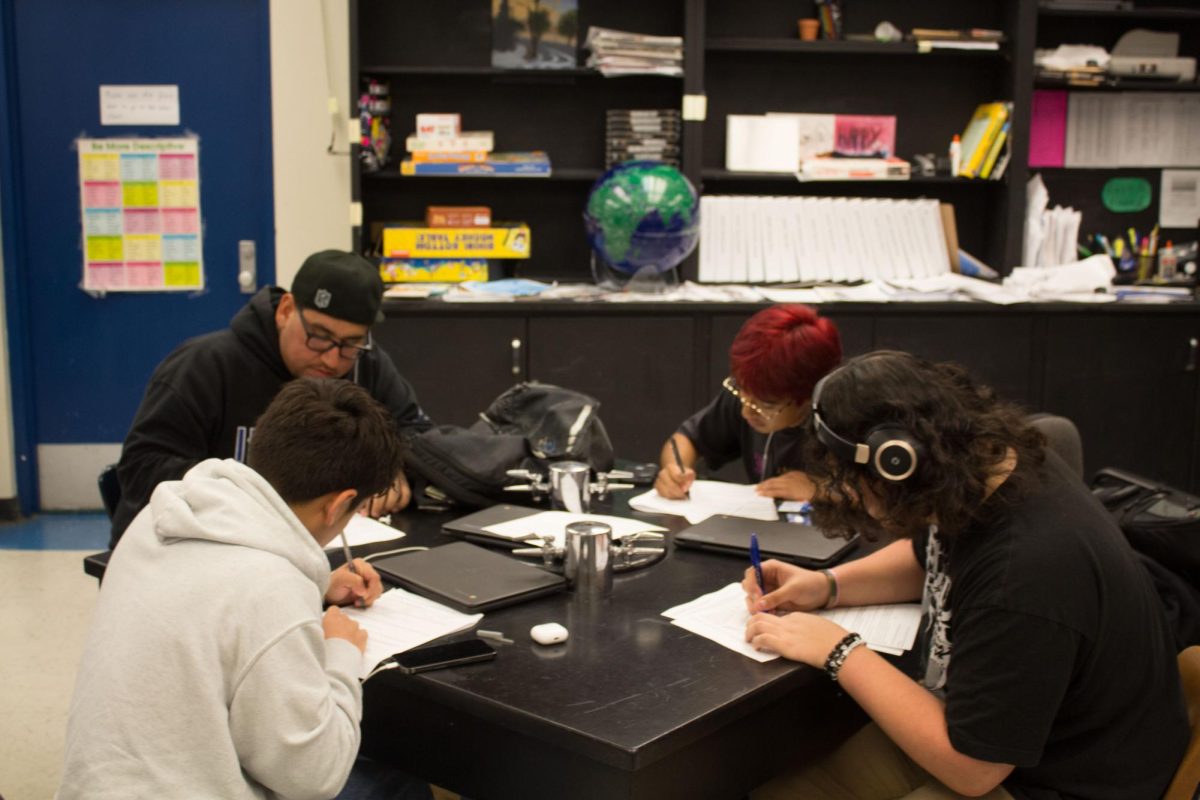
It’s a sentiment echoed across all subjects, with most teachers citing the threat of AI-generated work as the main reason to keep tests and quizzes on paper, and the fact that a printed exam was the only assessment they felt confident wouldn’t be touched by a chatbot.
The survey found that paper use varied dramatically by subject. Science teachers reported the widest range and the highest usage overall, with a weekly range spanning anywhere from 100 to 400 pages per week under normal conditions, increasing to almost 500 or 700 during busy weeks, mainly due to labs, which cannot be done online. English classes shared similarly variable data, due to essays or annotations. History teachers were commonly on the lower end most weeks, maybe spiking whenever there were tests (during finals week).
Teachers with smaller classes (typically under 40 students) reported weekly totals ranging from zero to 100 pages. Teachers with 70 to 120 students typically fell in the 50 to 300 range. But the largest classes, with teachers having 130 to 170 total students, showed the widest variance, anywhere from zero to 500 pages per week. This means that a single busy week for a large-class teacher could consume almost as much paper as a smaller class teacher prints in an entire month.
The survey also indicated that teachers of freshman and sophomore classes tended to print more consistently throughout the year, using paper for practice packets and classroom management as much as for assessments. AP and upperclassmen teachers skewed heavily digital for day-to-day instruction, but printed almost everything for tests and quizzes, citing AI as the primary reason.
Beyond weekly classroom printing, the school’s three benchmark projects add another layer. QUEST, which began in 1995, has a packet of roughly 53 pages or 27 pieces of paper that is given to the roughly 530 students in their senior year, meaning a little over 15,000 pages are used in printing it. WIP and CHANGE generate tens of thousands more. Across all three, a rough estimate puts the total near 30,000 pages, or roughly three trees, from the benchmark packets alone. Over the decades these programs have run, the cumulative number climbs into the hundreds of thousands, the equivalent of dozens of trees.
For reference, a single tree with a usable trunk of about 45 feet yields roughly 10,000 sheets of paper. By one estimate, benchmark materials alone may have consumed close to 47 trees through QUEST, 24 through WIP and 15 through CHANGE, which combines to nearly 86 trees.
Ms. Kamal, Irvington’s QUEST coordinator, said she worked to reduce the amount of paper QUEST uses outside of the packet. Many of the biggest components of the project, the final 6 – 10 page paper, are now submitted and graded digitally, meaning seniors no longer need to print their work. She also noted that the rubrics teachers use to grade different parts of the project have also been made entirely digital, further reducing unnecessary printing.
Some teachers have reduced their usage significantly, with many trying to remain as environmentally friendly as possible. But for many, several barriers remain. Unreliable internet access on campus was cited repeatedly, with one science teacher writing that the school’s internet was “TOO UNRELIABLE to use it regularly.” Teachers also mentioned equity concerns regarding the fact that not all students have working devices, and for some of the special education classrooms, paper-based materials were simply more accessible.
Many teachers also pointed to the years of research that show that students learn better and retain more information when they take notes and work on paper. Ms. Marsella-Jensen talked about studies showing that handwriting engages the brain more deeply than typing. She went on to reference “Digital Delusion,” a book arguing that over the last decade or two, screens in classrooms have decreased students’ ability to deeply and critically examine ideas. For some teachers, it is more important to figure out what needs to be printed versus what does not, rather than just eliminating one medium.
It also reduces the distraction of notifications, which can interrupt long-term memory consolidation.
Still, when asked what they would do if there were no constraints at all (no cost, no AI concerns, no tech barriers), a significant number of teachers said they would use less or even significantly less paper.
As of now, there is no formal school policy limiting how much any teacher or department can print. At the start of this year, the administration provided one ream of paper (about 500 sheets) to each department, but after that, departments were asked to cover their own costs out of their budgets.
An English teacher suggested that a tracking system, similar to one previously utilized, requiring staff to enter an ID or department code before printing, might bring some accountability back.
While digital tools have been introduced into classrooms to make education more efficient, concerns over AI use, access to resources and the impact of digitization on student learning have led teachers to return to using physical media in classrooms. At Irvington, this trend suggests that this practice will remain for the foreseeable future.