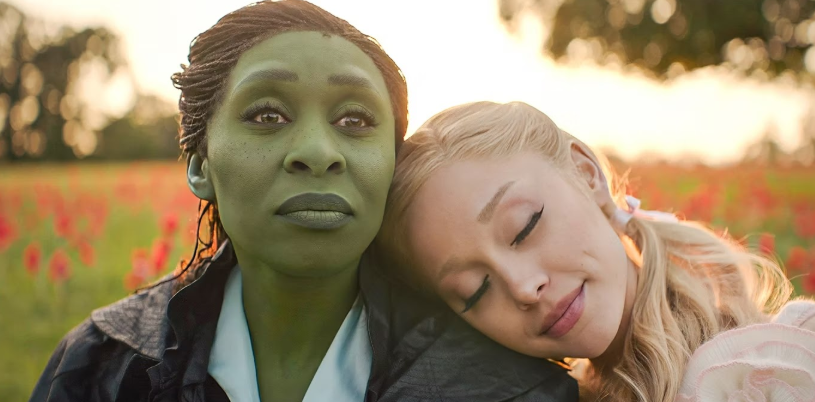
After a year of relentless, borderline exhausting marketing, “Wicked: For Good” finally arrived in theaters on November 21, 2025, and the release felt less like a movie premiere and more like the end of a national event. Universal Studios practically willed this film into cultural ubiquity with the countless partnerships, cast interviews, and TikTok trends taking over everyone’s timeline. And judging by its opening numbers — a record-breaking $218 million global debut, the biggest musical opening of all time — the spectacle paid off. Audiences showed up in packed double-feature marathons, many sporting pink-and-green fan outfits, and early reactions landing in two opposing but equally passionate camps: those who loved the emotional payoff and those who felt the sequel stumbled under its own weight.
In many ways, both sides are right, because “Wicked: For Good” is essentially Act II of the Broadway show on steroids. Director Jon M. Chu returns to wrap up the story of Elphaba (Cynthia Erivo) and Glinda (Ariana Grande), now separated physically and ideologically, in a world that is spiraling into cheerful authoritarian control. The film wastes no time easing viewers back-in with an immediate plunge into an Oz where propaganda is tightening, animals are losing their rights, and the Yellow Brick Road is built through forced labor in a landscape that looks much bleaker than the first film. The jump in tone is purposeful, but abrupt, especially for audiences expecting the charm and buoyancy of Part I.
The worldbuilding tries to expand the political undertones hinted at previously: flying monkeys are now surveillance drones, the Emerald City mirrors modern propaganda states, and Madam Morrible’s PR machine-like smile spreads misinformation with ease. The problem, however, is that though the world is bigger, the cinematography falls flat. The scenes look dim or grey, actors aren’t fully lit, and the sets lose color and texture, with fans even calling it “digital mud.” It’s disappointing because this is the film version of a story that’s already been adapted four times, and cinematography is the one thing movies can do better than any other medium. Instead of using bold lighting and framing to make Oz feel magical or dangerous, everything looks softened and even, like a soundstage. The result is worldbuilding that never hits with as much impact as it should, and an Oz that doesn’t come alive in a way the movie should let it.
Musically, Part II wrestles with the same inherent challenge as the stage show: Act II simply has fewer bangers. Still, some songs land beautifully. “No Good Deed” is a powerhouse showcase for Erivo, easily one of the film’s peaks, visually bold and emotionally gutting. “March of the Witch Hunters” is unexpectedly chilling, and Ethan Slater’s acting as Boq truly brought out the intensity of his hatred (but no spoilers!). “For Good,” the emotional climax, still delivers one of the franchise’s best scenes, with Erivo and Grande giving the duet this tenderness.
The film also adds two new songs, “No Place Like Home” and “The Girl in the Bubble,” but neither felt essential. They attempt to fill gaps in character arcs, but often slow down scenes that were already struggling to maintain momentum. This connects to the film’s biggest issue: pacing. The sequel (which isn’t really a sequel) wants to be everything — political drama, emotional epic, romance, and blockbuster musical — and the result is a narrative that moves both too quickly and too slowly. Scenes shift abruptly, emotional beats cut off early, and plot resolutions pile up without enough room to breathe. Ironically, even with the inflated runtime, certain arcs still felt rushed, especially those tied to Wizard of Oz’s original lore.
Audience reactions reflect this divide. Many praised the film’s performances — Erivo for raw intensity, Grande for surprising emotional depth — and celebrated the finale as a tearjerker. Others criticized the murky visuals, the added songs, and the uneven structure, calling it an unsatisfying conclusion.
Ultimately, Wicked: For Good isn’t a failure, but it doesn’t reach the heights, the expectations set by Part I, which is why I would rate it a 3/5. It is an ambitious, chaotic heartfelt attempt to elevate Act II’s original weaknesses. The film’s emotional bears shine, its stars deliver amazing performances, and its finale is undeniably moving. But its countless structural flaws keep it from becoming the sequel it desperately wants to be. It is, in every sense, Act II on steroids: bigger, louder, heavier, and both improved and strained in its ambition.