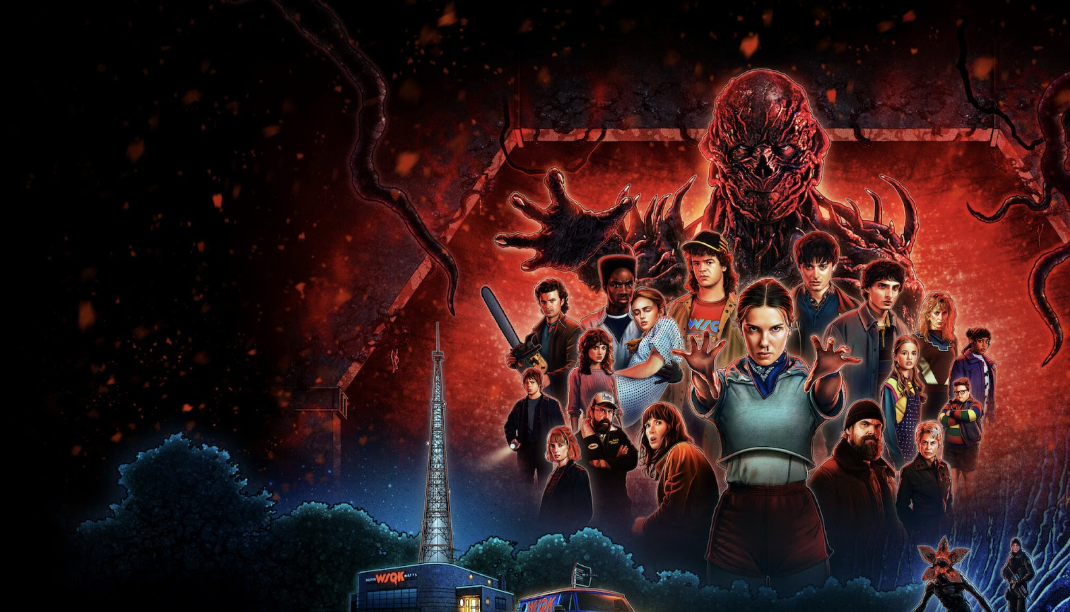
For nearly a decade, “Stranger Things” has been one of the most influential shows of its generation. What started as a small sci-fi mystery became a global phenomenon, turning its young cast into stars and creating one of the most passionate fandoms on the internet. Season 5 was marketed as the grand finale to this long-running story and was split into Volume 1 and Volume 2. While many fans, including myself, agree that Volume 1 was the stronger half, the ending in Volume 2 left much of the fandom frustrated and disappointed.
Season 5 follows the Hawkins gang as they face one last Upside Down threat, with Vecna returning as the final villain. Will’s psychic connection grows stronger, Eleven continues to struggle with the cost of her powers, and everything builds toward an all-or-nothing battle meant to finally end the Upside Down. In the finale, Vecna is defeated, and the Upside Down collapses. Eleven appears to sacrifice herself to permanently sever the connection between Hawkins and the other dimension, ensuring that no one can ever use her blood to create more superpowered children. The story then jumps ahead months later, with Mike telling a hopeful but ambiguous story about her possible survival, leaving her fate unclear.
This ending is where the show lost me and many other fans. Vecna and the Mind Flayer’s defeat felt far too easy for a villain who had been built up for multiple seasons. After all that buildup, the final battle lacked the emotional and narrative weight it should have had. On top of that, the finale played things too safely. Very few major characters faced lasting consequences, which made the supposed “end of the world” feel strangely low-stakes. A lot of the finale was also painfully predictable, with fans having guessed major plot points long before the episode aired.
One of the biggest controversies was the handling of Will and Mike, often referred to as “Byler.” While I never expected the two of them to actually end up together, the way the show handled their dynamic still felt frustrating. Stranger Things spent years building emotional subtext between Will and Mike, only to continue highlighting it in Season 5 without offering any real resolution. Instead of tying that storyline up earlier, the show seemed to drag it out until the very end, keeping fans invested without ever giving them clarity. For many viewers — especially those who related to the idea of Mike being closeted or struggling with his identity — this felt less like intentional storytelling and more like a way to hold onto audience attention for as long as possible.
Eleven’s ending was even more painful. After everything she’s been through, being forced into yet another sacrifice felt deeply unfair. She spent her entire life being treated as a weapon and never really got to be a normal girl. To end her story with death or ambiguity felt like reducing her to a plot device instead of honoring her growth. Like many fans, I believe she deserved a future, not just a tragic ending.
Mike also suffered from weak writing this season. Once an emotional, passionate leader, he felt strangely hollow, as if his personality had been drained. This made his relationship with Eleven and his final moments feel far less impactful than they should have been.
That said, Season 5 wasn’t all bad, hence my ⅗ star rating. The nostalgia worked, the cast still had chemistry, and some individual moments were genuinely touching. Seeing the group together one last time reminded me why I loved this show in the first place. But in the end, the finale missed its chance to truly honor these characters. Like so many fans, I’m left feeling that Stranger Things will be remembered more for how strong it began than for how it ended.