
Editors’ Note: This article uses records provided at the courtesy of the Washington Township Museum of Local History in Fremont, California.
“It has bothered me for some time why people gripe and gripe about things but never do anything about them. People with their opinions and such things as the war in Vietnam, student unrest, and pollution,” wrote Carol Kochalka, a student at Washington High School in the 1970s.
It was a letter to the editor that was published in a 1971 edition of The Argus, a local daily newspaper that used to serve Fremont. Today, local students have been voicing their opinions through direct action. In the last few weeks, Irvington students, along with other high schoolers across the wider Bay Area, have led a series of school walkouts to voice their opinions against Immigration and Customs Enforcement (ICE) and increased federal deportation tactics under President Trump’s administration.
This history of student activism has roots in the Tri-City area’s local history. The Voice compiled records of student activism in the 1960s and 1970s in the Tri-City area, notably surrounding issues of climate change and the Vietnam War.
The Vietnam War (1954-1975) had an impact on local youth during this period, with young men from the ages of 18 to 26 experiencing the military draft, which escalated from 1964 to 1973. A plaque in Irvington High School’s courtyard commemorates its students who lost their lives after being drafted into the conflict. National opinion toward the war began to shift between 1965 and 1967, with discontent largely fueled by the military draft and rising coverage of casualties.
On Wednesday, October 15, 1969, students at Washington High School marched from their school’s campus to the local Army and Air Force recruiting center on Maple Street to hold a peace vigil. The demonstration was part of a larger, national movement that day, the Moratorium to End the War in Vietnam, in which millions of Americans showed up at rallies and protests to make their voices heard, gaining the support of “nearly 80 senators and congressmen,” The Argus reported.
Cruz Cavillo was a student at Union City’s Logan High School in the 1960s who was drafted into the Vietnam War at the age of 18, soon after finishing high school. Cavillo has memories of his experience in the war, from going through training with bayonets and machine guns to having to defend himself from the Vietcong and experiencing Post-Traumatic Stress Disorder afterward. He recounted how many of his comrades who were drafted with him, including his high school classmate, Private Larry Johnson, who did not return from the war. “It’ll always be part of my life,” Cavillo said.
Upon returning to the United States, he remembered landing in Oakland to the sight of anti-war protestors. He recounted how he and the other soldiers with him were instructed by their sergeant to pretend to be ready to fire with their rifles to disperse the crowd. “I was angry. We thought it was our job to go and protect our country,” he said.
This era also saw a rise in awareness of the environment. Rachel Carson’s “Silent Spring”, published in 1962, brought the harmful effects of pesticide use to light. In doing so, it also brought the public’s attention to the other harmful effects of industrialization, most notably the pollution caused by cars, airplanes, and factories.
Patricia Schaffarczyk, a Collections Manager at the Washington Township Museum of Local History in Fremont, was a senior at John F. Kennedy High School from 1965 to 1966. As a student at Kennedy and Washington High Schools, she remembered learning about local student activist organizations. Reflecting on growing up in this environment, Schaffarczyk said, “I felt like things were gonna explode. There was so much tension in the country, especially around civil rights, the Vietnam War, women’s rights, and pollution.”
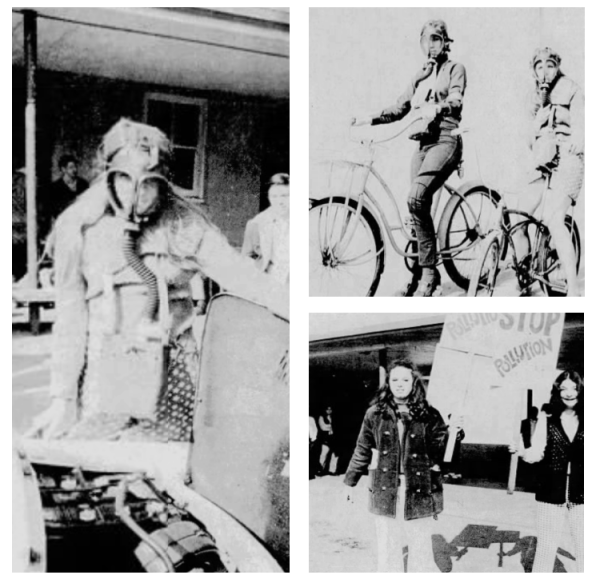
On January 23, 1970, The News Register, which formerly served the Tri-City region, reported that Washington High School students were planning an antipollution protest on Anti-Pollution Day on January 30. According to Mike Agee, a political science teacher at Washington High School, this protest was a “symbolic protest against our environmental problems,” that he hoped would inspire reform at the state and national governmental levels. Students wore gas masks and held up picket signs with messages calling for an end to pollution. Similar demonstrations were also planned at Mission San Jose, Irvington, and Kennedy High Schools.
Looking between the past and the present, Schaffarczyk has noticed parallels.“The civil unrest of today is similar to that of the 1960s,” she said.