
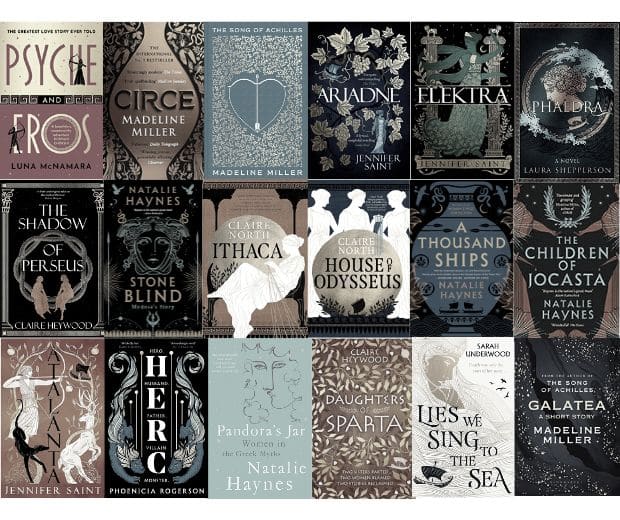
In The Silence of the Girls, a retelling of the Trojan War by Pat Barker, the most requoted lines go like this: “‘I do what no man before me has ever done, I kiss the hands of the man who killed my son,’ declares Priam when he prostrates himself before Achilles begging for Hector’s body. ‘And I do what countless women before me have been forced to do,’ Briseis thinks bitterly, ‘I spread my legs for the man who killed my husband and my brothers.’” The quotation and its popularity amongst book reviewers, bloggers, and New York Times journalists alike is rightfully earned. It perfectly sums the overarching theme of Barker’s book, critiquing how traditional renditions of the epic poem The Iliad overlook the suffering of women as secondary to male pain. It also sums up the attempted themes of The Silence of the Girls’ spiritual siblings – Greek mythology retellings that try to center female characters. Barker’s book was printed in part to refute the idealization of Achilles spurred by The Song of Achilles by Madeleine Miller, where the Greek hero Achilles’ textual status as a slaveowner was softened in order to make his romance with Patroclus more sympathetic. Greek myth retellings have populated the western world since the days of the ancient Greeks themselves, but the modern genre conventions tend to see such retellings as feminist recentering onto the lives of women in Greek stories. While a promising aim, such efforts have proven overwhelmingly problematic, becoming gimmicky and ill-thought, as the majority of feminist retellings fail to be feminist at all, fail to engage meaningfully with the source material, and result inforced modernity.
The overwhelming amount of feminist Greek retellings fall into a trap. They rehash an age-old story, claiming to be from a feminist perspective, while using the avenue of a female protagonist to tell a story that is still ultimately male-centric. Such is the case with Ithaca by Claire North, a book ostentatiously about Queen Penelope of Ithaca and the 20 years she spent ruling her kingdom in her husband’s absence. Yet, despite the premise, the book did not ever portray Penelope as engaged in actual politics. She is not the driver of the plot – Menelaus is. She is not even the narrator – that would be Hera. Instead, Penelope’s purpose in the book is to react to her husband’s journey relayed to her by bards. making the story revolve around Odysseus’ actions to which Penelope can only react to, not chart her own course. North’s inability grant Penelope her own plot, arcs, or friends, is not one a fault of Penelope herself. The Penelopiad by Margaret Atwood did better with the exact same characters, building where North did not on Penelope’s interactions with her maids, the way she built them as a spy network for her own power – and the way she discarded them for the same reasons. Atwood’s Penelope is a complex character. She is a queen kind to her servants. She is seeking safety. She is a woman in a position of power who throws her servants beneath the proverbial bus once she has used them for her own benefit. In comparison to that, North’s Penelope is a non-character.
Furthermore, the majority of retellings fail to engage with the source material, relying on pop culture that diminishes these retellings’ potency. Hera, for example, flanderized the main character into a long-suffering underdog that marginalized her violence against other women. Lore Olympus flanderized in the other direction, creating a Hades and Persephone romance relying on YA tropes that erased the incest, possible rape, and reduced Demeter’s grief to an annoying obstacle for the couple. And in Wrath Goddess Sing, Achilles’ sexual abuse of women was sidestepped by having her be a transwoman. This deproblematized the tale but also made it far removed from original texts as to be justified in calling it a ‘retelling’. Sarah Underwood, author of The Lies We Sing to the Sea, a sapphic retelling of The Odyssey, confessed in an interview that they did not read The Odyssey before writing the book, believing that it was “too long and written in a ‘prosey’ way.” The effect of relying on cultural osmosis in order to write retellings is that they fail to address any questions raised by the text itself, and are incapable of actually saying anything meaningful about a text the author has by their own admission not read. Ignoring precedents in order to write a pop ‘retelling’ doesn’t does both the original story and the characters themselves a disservice by misrepresenting them without any genuine understanding of who they are, the messages that the original text was attempting to send, things that could only be garnered from original text. No, a person does not need to read Ovid to have opinions on Greek mythology but reading it allows for opinions that can be taken seriously by others.
None of this is to say that retellings as a whole fall into these pits. They’re evidently important on their own. Retellings, especially ones that center on women, force audiences to grapple with which stories are worth telling. With what pre-existing stories look like when we take our eyes away from the heroes, and onto the people that were left out of the original narrative. The Iliad is a story about Achilles, Agamemnon, Ajax, Diomedes, Hector, Paris, Patroclus. But what about the sex slaves, servants, laundresses, latrine-diggers? Surely, they existed? What about them? In A Worker Reads History by Bertolt Brecht, the poet asked, Caesar beat the Gauls/Was there not even a cook in his army?/Each page a victory/At whose expense the victory ball? Retellings are a way to answer these questions, and force us to hear the voices of those who could not, from the beginning, speak for themselves. This is something Virgil’s Aeneid, for all its been likened as state-sponsored fan fiction, did well. By focusing on Aeneas, a minor character of the original text, and expanding on his traumas as a war refugee, it extrapolated on what the fall of Troy would have meant for the victims rather than the victors. Certainly, it serves as a better critique and conversation with The Iliad than The Song of Achilles, which for all of its beautiful prose, reinforces the narrative of the Greeks as righteous and honorable rather than challenging it.
Greek myth retellings overwhelming refuse to make their protagonists ‘problematic’ or in line with their textual selves. Put it this way: the Achilles of The Iliad is a slaveowner. Her name is Briseis. When Agammemnon steals his sex slave from him, Achilles refuses to fight with the Trojans. Yet, in Madeleine Miller’s The Song of Achilles, while Briseis is included, the author portrays her and Achilles’ relationship in the most positive light possible. Achilles enslaves her to ‘save’ her from Agammemnon, he is kind to her, and Briseis’ purpose is to support Patroclus and Achilles’ romance. This is understandable,readers are less included to support a romance if one character is a rapist. And because the treatment of sex slaves in the Epic Cycle was ill-commented on, writing the fact of sex slavery out on paper could feel misogynist as well. And yet, the trend in works and retellings such as Miller’s works to pretend their Greek heroes were not rapists borders misogyny itself, removing the textual suffering of women just so that the male main characters could be defanged, appearing more palpable to a modern audience. Portraying the suffering of women in the original text in retellings is not glorifying that suffering, but rather representing it, and acknowledging the way agency was be taken from oppressed people in a way that centers the suffering of the victim rather than the perpetrator. It was possible, surely, that Miller could have written a version of The Song of Achilles that showed Patroclus and Achilles as in love and have Achilles as an enslaver. The original Illiad already did so. But instead the entire issue was placed as an Agammemnon-specific issue, erasing Achilles’ culpability in both personal slavery, and in supporting the system entirely.
None of these issues are exclusive to Greek myth retellings, of course. But the crimes of other genres does not render that of the retelling industry obsolete. In the literary boom after the musical Hamilton (2015) was released, over a dozen books purportedly about ‘Elizabeth Hamilton’ were published. Like the average feminist Greek mythology retelling, none of those books actually centered Elizabeth Hamilton at all. Instead, they would be on average 600 pages, 500 of which would cover Eliza’s relationship with her husband, and devote an epilogue of 50 pages to her 50 years after her husband’s death. Sidelining Eliza’s contributions post-her husband’s death was an acceptable choice for the musical, since it made no claims about focusing on the lives of anyone other than its titular character. But in a book about Eliza herself, this choice is immeasurably offensive, as it reduces the majority of a book about Eliza into a book where she is a secondary character only responding to the actions her husband takes. It is also lazy. So it is with Greek mythology retellings. They have the ability to improve, but not if they continue to exist as they are now: refusing to explore the inner lives of the characters they purport to be about, refusing to engage with the source material, and refusing to explore the moral stains that their characters have.