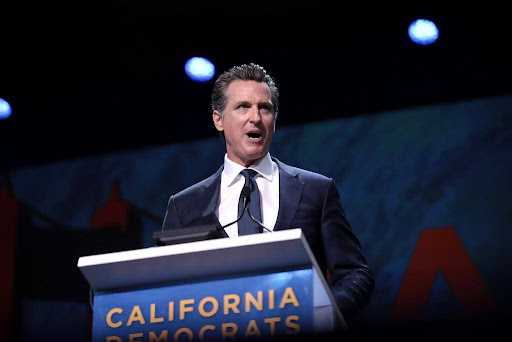
Boasting a booming economy, rising education metrics, and billion-dollar investments in homelessness, Governor Gavin Newsom has painted his tenure as a model of progress. On paper and in Governor Newsom’s words, California is the pinnacle of success, with a Gross Domestic Product (GDP) rivaling Japan’s, increased funding for public education and countering homelessness, and a variety of inclusionary and equity laws. Yet as the fine print becomes clearer, not all is as improved as it is said to be.
Despite an avalanche of new legislation, many of Newsom’s reforms read more like symbolic gestures than substantive change. Specifically, AB 3216, the Phone-Free School Act. Framed as a mental health measure, something necessary for the greater good of students, Governor Newsom justified the decision by stating, “We know that excessive smartphone use increases anxiety, depression, and other mental health issues – but we have the power to intervene. This new law will help students focus on academics, social development, and the world in front of them, not their screens, when they’re in school.” However, the approach taken is arguably unholistic. Critics call it what it is — a distraction. The law does nothing to fix California’s chronic shortage of counselors, overcrowded classrooms, or the underfunded mental health programs it pretends to address. It’s purely performative policy – monumental on paper, hollow in practice.
Additionally, concerns about California’s political structure further taint Governor Newsom’s image. California’s redistricting process, intending to prevent gerrymandering through its independent citizens’ commission, has garnered scrutiny due to allegations of partisanship. Specifically, this has been seen through Proposition 50. Writing off the unethical practice as a combative measure against current President Donald J. Trump, Governor Newsom ignores the hypocrisy and the negative precedent of resorting to unethical means when an opponent does the same being set. Although Newsom has not been directly tied to these controversies, critics argue his administration has shown little urgency in strengthening transparency or addressing public mistrust in how political boundaries are drawn.
To his credit, Newsom has directed substantial resources toward housing, education, and clean energy initiatives, taking advantage of California’s fiscal capacity to fund ambitious projects. Funneling nearly $900M towards homelessness, $150M towards climate change, and hundreds of millions on various other causes, Governor Newsom has supplied many communities with the capital to thrive. But money does not equate results, and California’s major pain points still linger, not truly healed from the weak bandaids which Governor Newsom attempts to slap on. Specifically, homelessness has reached an all time high over his term and nearly a quarter of the nation’s unhoused population resides in California. On paper, his term is exceptional, with progress measured in the billions of dollars he can funnel, yet this money is never truly felt by Californians, rendering his term a paradox.
After observing the illusion of California perpetuated by Governor Newsom, one could speculate that the desired result of his term is to secure the role of a viable candidate for president. The seemingly monumental pieces of legislation providing aid only at face value and blind fanaticism for California, Governor Newsom appears to be promoting a product which he has not truly cultivated. Beneath the billions lies the same unresolved crises, papered over by press conferences and polished metrics. Each budget rollout or biased promotion of California, feels less like leadership and more performative, reflecting the branding of a man testing his national appeal. In the end, Gavin Newsom’s California looks like a campaign ad for a job he hasn’t applied for yet, a success story to be sold rather than written.