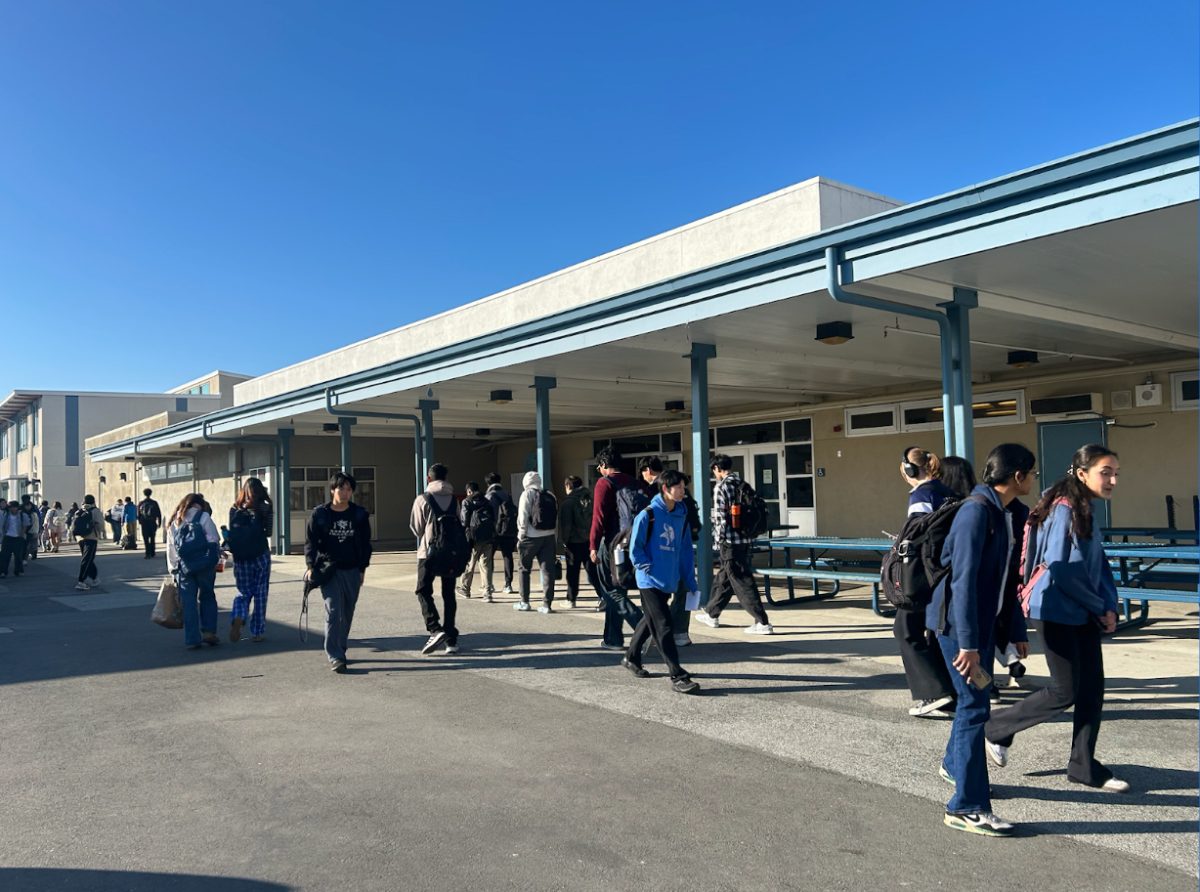
As the lunch bell rings, Irvington students rush towards the lunch line, crowding into the cafeteria. They pile their paper trays with fresh grapes and orange slices from the salad bar, pizza slices and cheeseburgers from the hot food section, or yogurt parfaits and ceasar salads from the cold food section. When the students get to the end of the line. However, instead of paying $2.25, they simply input their student ID to claim their free lunch.
California was the first state to implement the Universal Meals Program, through Education Code Sections 4901.5 and 49564.3. As students returned from Quarantine and online school, they were greeted with a daily provided breakfast and lunch for all, regardless of their free or reduced price eligibility. Along with this, the Universal Meals Program requires high-poverty schools (schools with over 40% of students who are eligible for free meals) to participate in a federal provision and for state meal reimbursements to cover the cost of the program. The move was praised by parents, educators, and the public as a progressive policy helping students. Yet in the schools, the results were mixed.
A report from the journal Nutrients surveying school food service authorities found that 44.3% believed that food quality improved in most schools in California in the first year of the Universal Meals Program. Yet the same study also reported challenges, such as variation in supply chains and staffing.
In Irvington High School, students also have mixed opinions. While it’s nice to be able to pick up food whenever you’re hungry, and takes the burden off parents, Jolene Cheung (11) notes the small portion sizes. “I think it’s more of a snack rather than a meal,” said Cheung. Students also listed a lack of variety as an issue. Particularly, Anvi Verma (10) describes a decrease in vegetarian options after the program was enacted, “sometimes there’s barely any options for vegetarians, and it’s really inconvenient for those who can’t eat meat at all”.
In February 2025, Robert F. Kennedy Jr. was sworn in as the 26th Secretary of Health and Human Services. As a cabinet member under the second Donald Trump administration, he drastically reframed the Food and Drug Administration. He has been particularly outspoken in his campaign against processed foods, like chips or soda, in an effort to prevent chronic disease in American children. He’s targeted school lunches as the epicenter of this crisis through his Make America Healthy Again (MAHA) program, leading to greater national focus on processed foods. In Texas, Governor Gregg Abbot signed SB 25, enacting many MAHA policies, most notably mandating labelling for certain ingredients in food products. In California, Governor Gavin Newsom has created Assembly Bill No. 1264 to phase out ultra-processed foods from public schools. Starting in January 2026, the law aims to completely remove ultra-processed foods by 2032 and to define the term for the first time. It outlines foods with high levels of sodium, sugars, saturated fat, artificial sweeteners, colors, and thickeners as ultra-processed.
Supporters of the law noted excitement from farmers, signaling a transition to more locally sourced food, such as grass-fed beef or organic milk. Bernadette Del Chiaro, a senior Vice President for the Environmental Working Group, an organization that cosponsored the bill stated, “I can tell you that farmers are really excited about it — nothing would please them more than to be able to deliver food directly to California’s kids and schools.”
On the other hand, this complicates matters for the companies that provide food to schools, facing the dilemma of having to reformulate their food or move out of California. “If they want to continue to sell in [California], then they need to reformulate their product and make modifications so that it wouldn’t include harmful additives and be considered an ultra-processed food of concern,”said Assembly member Jesse Gabriel who authored the bill. Extra costs in manufacturing, new equipment, and changes in staff training are among the challenges that California’s lunch program, which is particularly vulnerable to changes in budgeting, will face in the upcoming years.
For now, students sit on dusty blue lunch tables or on the blacktop, chowing down on cheeseburgers and pizzas. While school lunch may seem forever the same, California’s new bill brings hope for real, locally sourced foods. A first in the nation, it’s a step in the right direction for children across the country.