When it comes to modern poetry, it seems that we’ve lost our way.
It’s true that poetry should never have rules. After all, it isn’t required that people write poems about nature or the smell of petrichor for 10 verses straight. Nor is rhyming strictly required – free verse is its own art. People can just write about anything that interests them, even as something as simple as themselves. Yet, as poetry becomes a widespread platform for people to express their feelings, there comes a point where individuals treat poetry only as a medium for surface-level experiences, commercializing it by tapping into trends, rather than mixing in introspection or sociopolitical themes. Furthermore, the poetry format they use may as well just be prose with no greater attention to the art than randomly inserted line breaks.
Lyrical poetry (a musical form of poetry that captures emotion from a first person point of view) has been commercialized and has become one of the only focuses of modern poetry today, hindering new poets from learning other concepts. According to The Walrus, a Canadian newspaper, the “dominance of first person poem has killed off the rich possibilities available to poets.” Let’s face it: lyrical poetry is great, but the more you go on, the more difficult it can become to merge depth with personal experience, especially because many of us haven’t been taught to do so. And indeed, many self-published poets have not been taught to do so. Modern poets try to tell us that if anyone tries to put enough emphasis on their words,
whether that be / with word breaks / Like this, / Or flowery vocab / ulary that makes no sense / anyone / can be a poet.
According to Matthew Walter, a New York Times Opinions columnist, the link between poetry and nature has been broken. He details T.S. Elliot and his role in the modernism of poetry from the 1920s. He specifically says some types of modern poetry “have…alienated us from the natural world” (New York Times).
This critique against poetry calls many questions: Do we need to be writing poetry that talks about nature, ignoring how individuals may write poems in a larger scope of shared identity?
The answer is no, but as time progresses, poetry loses its sophistication.
One of the reasons is the usage of unnecessary line breaks within poems. Social media has convinced us that anyone can write poetry, rather than establishing poetry’s importance from an analytical, purposeful perspective.
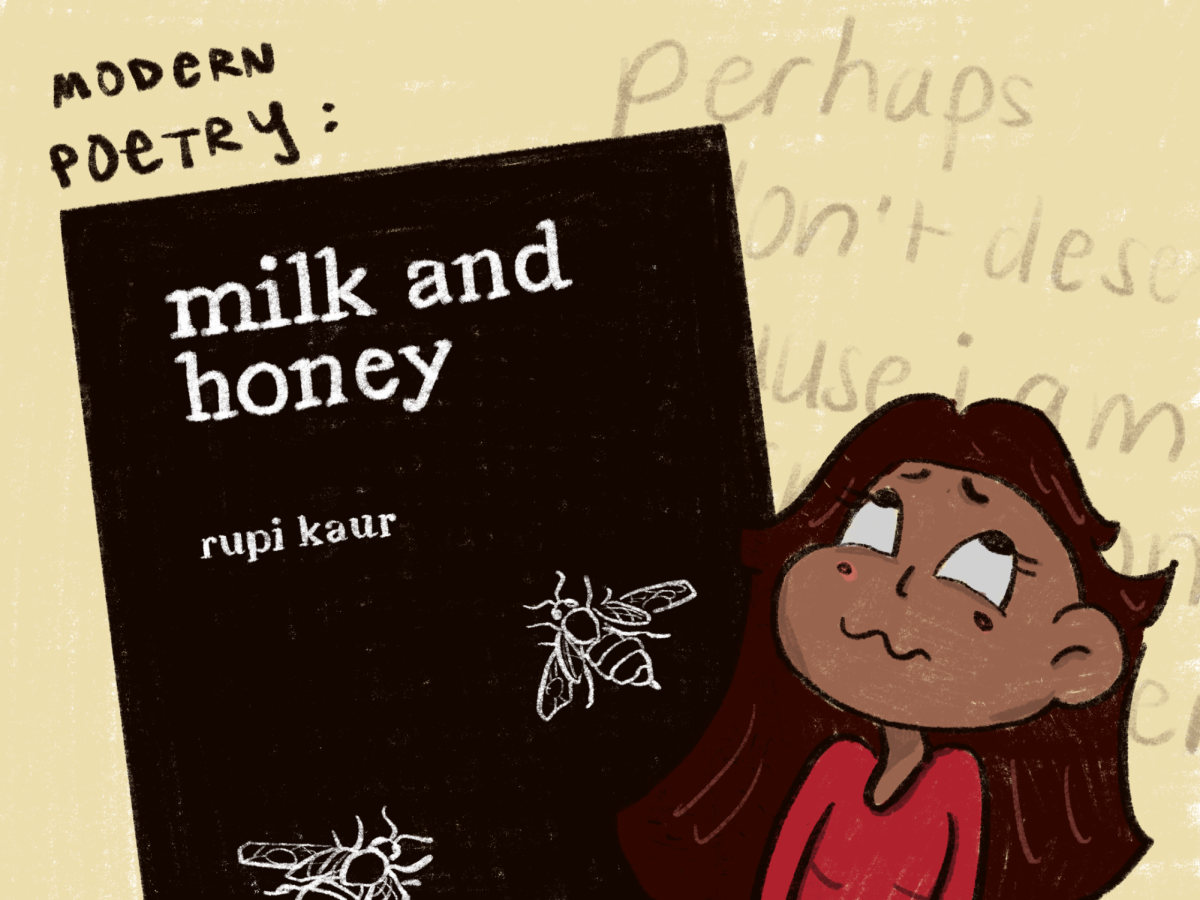
A heavily scrutinized poetry book, Milk and Honey by Rupi Kaur serves as a great example of weak syntax. It is true that this poetry book covers heavy themes of feminism, grief, loss, and trauma, and that it has convinced others to start writing poetry as well. However, the prose and the usage of line breaks shows why the book struggles to carry a larger impact, giving an aura of forced depth.
To quote the book,
“perhaps / i don’t deserve / nice things / cause i am paying / for sins i don’t / remember”
Some of Milk and Honey’s poems hold raw messages, but by breaking apart the poem into multiple stanzas, the poems lack resonance and impact. The line breaks do not occur in places that would add on to the syntax or analysis of the messages presented. With how many of them there are, it does not give the reader a chance to properly analyze what each fragment may mean nor put much weight onto a specific part. This line would work just the same if it were in prose, but if it had to be poetry, a possible better formatting for the quote could have been,
“perhaps / i don’t deserve nice things / cause i am paying / for sins i don’t remember”
In this case, the resonance of each individual fragment would be stronger and give the reader more to consider in each part.
The scarier thing about watching the critique of indie-published poetry and its importance is that it brings many questions forward about if poetry has any boundaries anymore. Publishing a few Tumblr or Instagram posts are considered the equivalent of building a solid poetry foundation for future writers to look up to. But publishing short little quotes doesn’t equal depth or showcase an impact on society (if that was the aim of Milk and Honey, which ironically started off as a set of poems off a Tumblr blog). Line breaks alone cannot turn prose into poetry.
However, there are modern poetry books that touch upon the renaissance of poetry today and do so well, possibly because they stray from modern forms of lyrical poetry.
Such examples include Louise Glück’s book, The Wild Iris. A Pulitzer Prize winner, her book covers themes of poetry, nature, faith, and mortality, causing readers to think about the themes of nature presented in the book. To better quote one of the poems from this book, The Garden,
“The garden admires you. / For your sake it smears itself with green pigment, / The ecstatic reds of the roses, / So that you will come to it with your lovers… /Admit it is terrible to be like them, / Beyond harm.”
This poem brings a sense of contemplation with its themes that seem to be directed towards the author. Although it carries a sense of personal experience and lyricism as many of her poems published do, it also forces the reader to think about the tranquil scenery of the garden in contrast to racing thoughts.
The line breaks are expertly utilized to add depth as well. The first four sentences function as the garden’s enticement to the audience, with stanzas two and three paralleling each other in how they describe the color of the garden. And then, after the trailing dots of the third stanza that draws the reader in, the fifth and sixth stanzas are a one-two gut punch refuting the prior four stanzas of awe. This is made especially effective by the varied fragment lengths, where rather than having all the same syllables as Rupi Kaur’s poetry, the contrast between the longer floweriness of prior stanzas make the short ‘Beyond harm’ hit even harder than it would otherwise. If Glück had instead written,
“The garden admires you./For your sake it smears/Itself with green pigment,/The ecstatic reds of/the roses so that you/will come to it with your lovers…/Admit it is terrible/To be like them,/Beyond harm.”
The words would still be beautiful, but be far messier and less cutting.
Poetry doesn’t need to be consumable, it needs to be explored and dissected. It doesn’t need to be broken up into meaningless stanzas to show depth, either. To solve the problem of lack of depth behind modern poetry, it is important to understand that poetry isn’t meant to be a pathway to success. Nor is it just prose with line breaks. It isn’t meant to replace prose-packed sentences or vignettes, and if an author’s intention is to publish a book of short quotes with flippant line breaks where it looks cohesive, the stanza breaks aren’t necessarily going to just make the prose better . Poetry isn’t just to tackle individualism, it’s meant to build upon larger messages that require depth to dismantle. For example, Simone White, in Of Being Dispersed, wrote,
“Just this morning hundreds, barefoot, rose, / to walk on water as testimony. / Our will to grip and destroy the physical laws; / it is the essence of navigation.”
This poetry uses resilience and the miraculous act of water-walking to describe Black resistance, forcing us to discuss themes such as human perseverance and faith. Most of the book remains personal, but with added depth from humanistic themes — this book remains a powerful symbol of Black pride. Rather than being about generalized quotations on life, or laments on pop culture as other poetry books tend to include, this book of poetry uplifts an entire community through contemplation of shared experience.
When we stop looking at poetry as a tool to gain something out of, force depth, act as a pop culture reference medium, or become an echo chamber for repeated messages, only then will there be a reform of modern poetry. Poetry doesn’t require unnecessary line breaks or nature-based depth to stay relevant: it can exist in both contexts, both reflecting modernity and a blend of exploration and depth. Poetry shouldn’t have to feel consumable, and when new poets understand this they will be able to go forward and create meaningful messages.